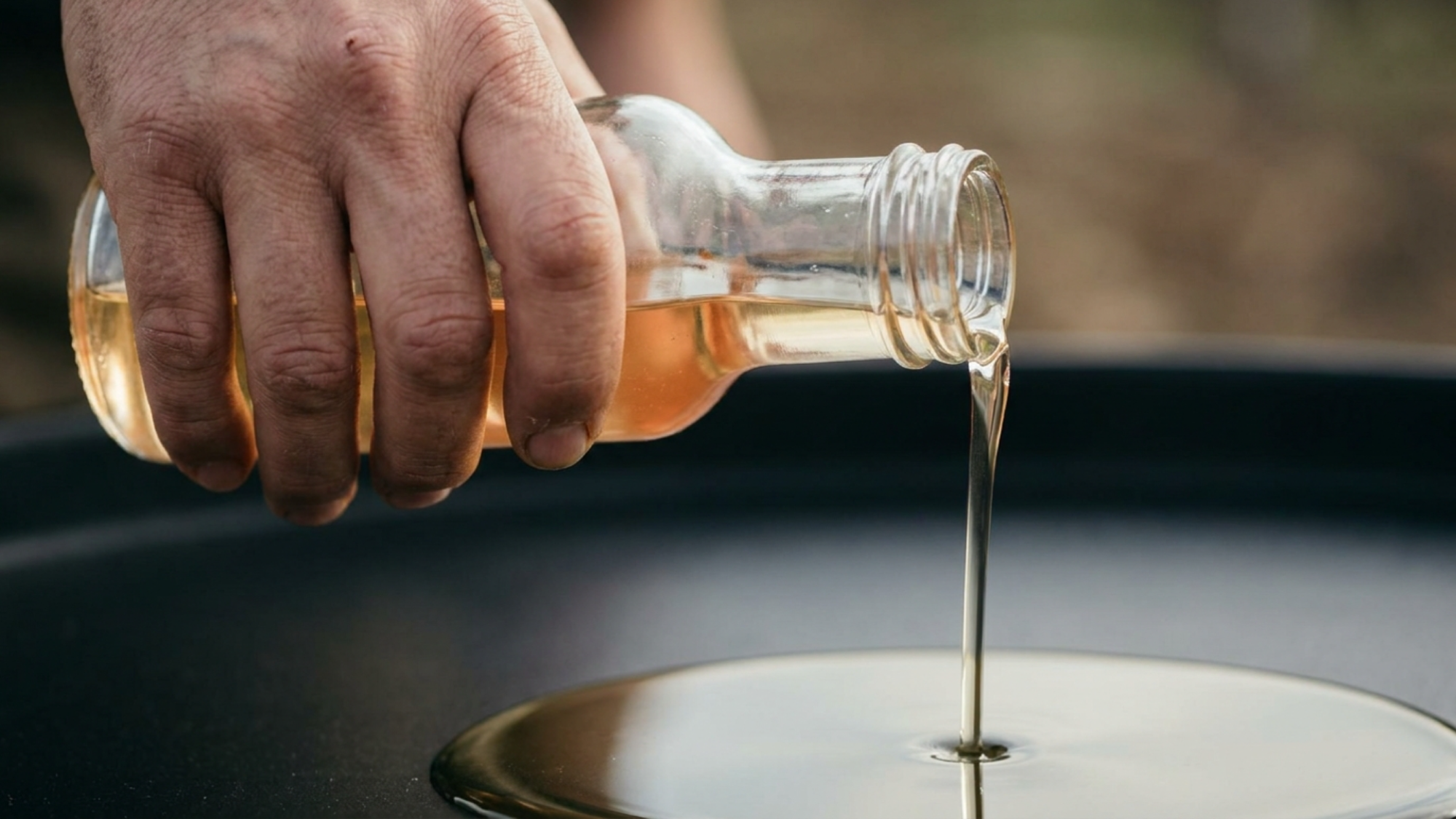
HOPO outperforms seed oils on oxidative stability, sits favorably against standard palm on saturated fat, and ships under chain-of-custody from a named operation. The science isn’t opinion — it’s a spec sheet, backed by peer-reviewed measurements.

Oleic acid (C18:1) has one double bond. Polyunsaturated fats have multiple. Fewer double bonds = fewer attack sites for oxygen.
Result: HOPO clears 50+ hours in Rancimat induction-period testing — 2–3× longer than typical seed oils in published frying trials.1
Spec minimum 420°F (NTC 5478:2007); typically measured 440–460°F for refined palm olein. Higher means safer, cleaner cooking under sustained heat.
Smoke point isn’t the differentiator — composition is. Per Fedepalma’s 300-cycle frying study, HOPO completed all 300 cycles without crossing the 25% polar-compound discard threshold, while soybean/palm blends failed at 95.2
No hexane residue. No partial hydrogenation. No interesterification. No bleaching with caustic chemical agents.
What goes in the fryer is what came out of the fruit — mechanically separated, physically refined, naturally stable.
Oleic acid is a monounsaturated omega-9 fatty acid — the same fat that makes olive oil famous. It’s stable, heart-friendly, and resistant to the heat damage that plagues polyunsaturated seed oils.
TOI’s HOPO typically delivers ~48–60% oleic acid — well above standard palm olein (~40%) and dramatically above soybean (~23%) or sunflower (~21%). The high oleic profile comes from the OxG interspecific hybrid (Elaeis oleifera × Elaeis guineensis), the American-African palm cross native to the Neotropics. Not genetic engineering. Just the right crop in the right soil.
Oleic Acid
A single cis double bond at carbon 9 gives this molecule its name. The structure resists oxidation, delivers stability under heat, and forms the backbone of a cleaner nutritional profile.
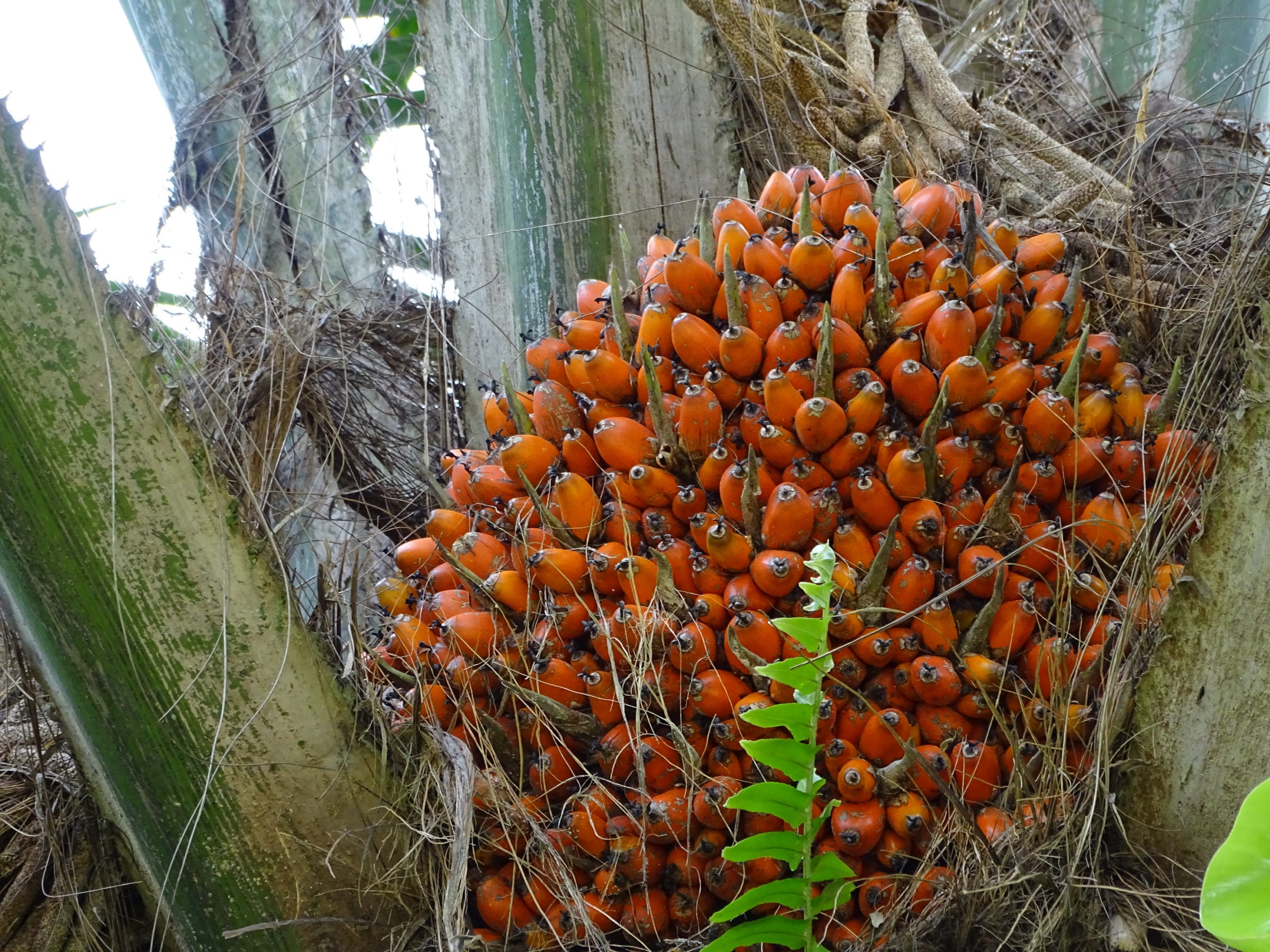
High Oleic Palm Olein is not the same crop as standard tropical palm oil. It comes from the OxG interspecific hybrid — a cross of two species of oil palm that yields a fundamentally different fatty-acid profile. Here’s what’s actually in the fruit.
The American oil palm. Native to the Neotropics — Colombia, Ecuador, the Amazon basin. Naturally ~50–60% oleic acid, low yield, slower-growing.
For commodity production, never made commercial sense alone. But the chemistry it carries is the prize.
The African oil palm. The global commodity crop — ~85% of world palm oil. High yield, faster-growing, but a less favorable fatty-acid profile (~40% oleic, ~47% saturated).
Workhorse genetics. Industrial scale. Standard palm.
E. oleifera × E. guineensis. The oleic profile of the American palm, with workable yields of the African. 58% oleic, 30% saturated, 11.5% PUFA (lab-verified, Intertek 2024).
Roughly 15% of Colombian palm production. Most of the world has never planted it. A handful of Colombian producers did.
The OxG cross isn’t genetic engineering — it’s conventional interspecific hybridization, achievable only because both parent species evolved on opposite sides of the Atlantic and only meet in places like Colombia where the American oleifera is native.
The fruit is denser, the bunches heavier, and the oil pressed from the mesocarp carries a fatty-acid backbone substantially closer to olive oil than to standard palm.
In 2025, Fedepalma’s New Business Development team partnered with the Food Technology Unit at the University of Caldas to run a controlled deep-frying trial: seven commercial oils, French fries at 175°C, frying until each oil crossed the 25% Total Polar Compounds threshold (the EU/US regulatory limit for discard) or until 300 cycles, whichever came first.
| Oil | OSI (Rancimat 110°C, h) |
Frying cycles to discard |
Trial result |
|---|---|---|---|
| HOPO (TOI) | 74.3 | 300+ | Cleared 300 cycles |
| HOPO olein (TOI) | 72.4 | 300+ | Cleared 300 cycles |
| High-oleic sunflower | 101.0 | 300+ | Cleared 300 cycles |
| Canola (rapeseed) | 14.4 | ~147 | Failed at ~147 |
| Sunflower (standard) | 16.5 | ~107 | Failed at ~107 |
| Soybean / Palm blend | 28.9 | ~95 | Failed at ~95 |
| Soybean / HOPO blend | 30.4 | ~134 | Failed at ~134 |
Polyunsaturated seed oils degrade aggressively under sustained heat — producing aldehydes, free radicals, and a darkening off-flavor product. HOPO sits structurally above the storm.
Repeated Rancimat and PV testing confirms higher oleic acid content correlates directly with longer induction periods and slower oxidative breakdown.
Food Chemistry · J. Am. Oil Chem. Soc.Peer-reviewed fatty-acid measurements (Mozzon et al., MDPI Foods 2020) document ~48–60% oleic and ~30–34% saturated in OxG palm olein, versus ~40% oleic / ~47% saturated in standard tropical palm olein.
Mozzon et al. · MDPI Foods 2020The U.S. FDA recognizes that high-oleic oils (defined as ≥ 70% oleic acid) may reduce coronary heart disease risk when substituted for high-saturated fats. TOI’s ~48–60% oleic profile does not categorically qualify for the FDA claim — we cite the science it’s built on, not the claim itself.
U.S. FDA Qualified Health Claim · 2018Hexane extraction is standard in virtually all seed oil production. Mechanical pressing of fruit mesocarp delivers a fundamentally different residue profile and label story.
CODEX Alimentarius · industry literatureThe receipts
Detailed technical specification, third-party COA, fatty acid breakdown, and frying performance data — all in one PDF.